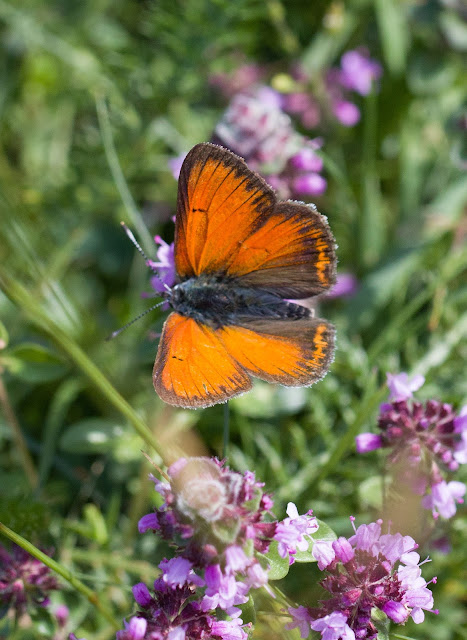
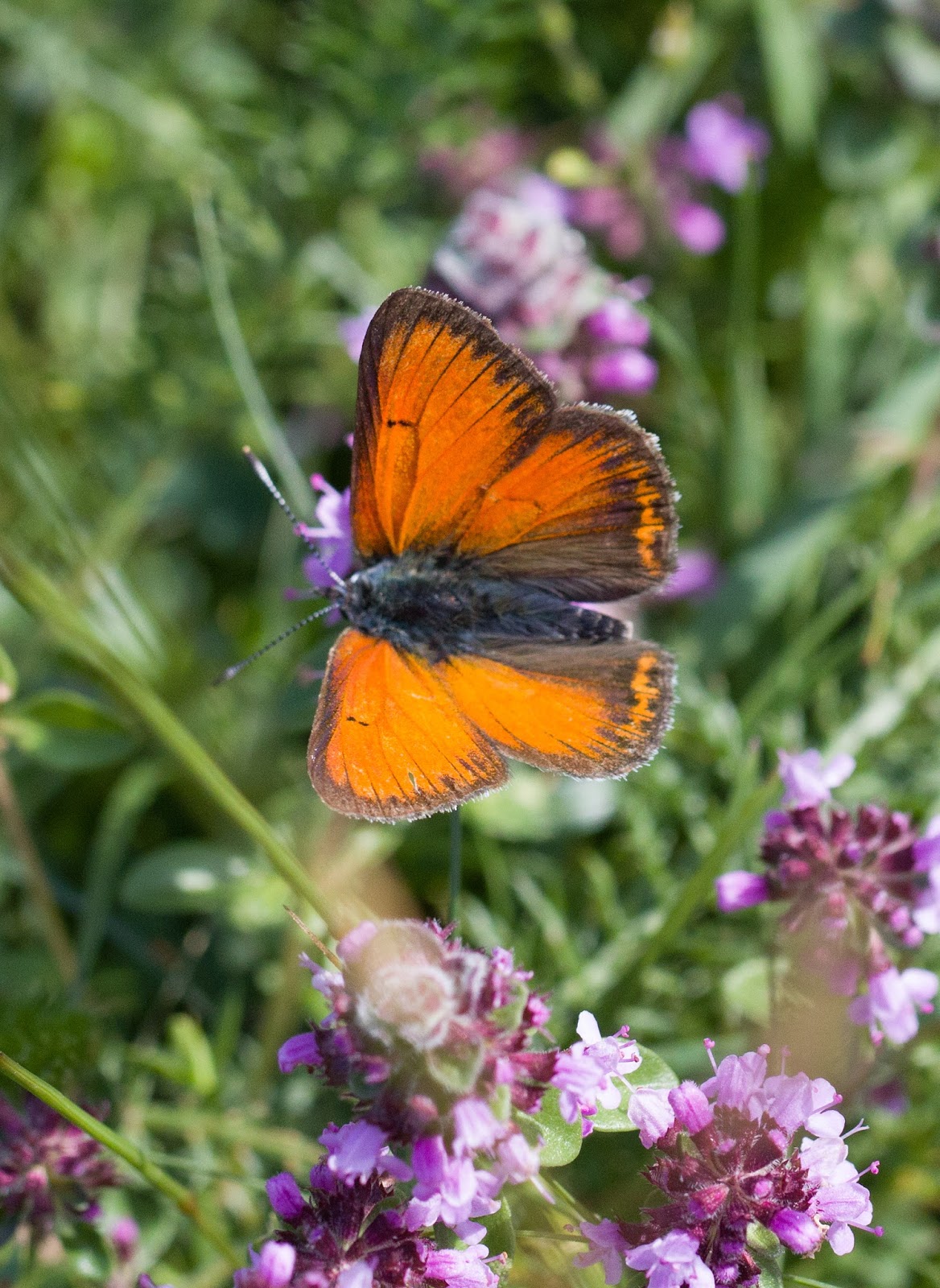
Today found us venturing further up the Vallé de Héas towards the Cirque de Tromouse. As the temperature rose towards a high of 25 degrees butterflies were on the wing early. Our first roadside stop gave us great views of Purple-edged Copper.

Also, my first distant Alpine Marmot, Marmota marmot - a bit of a surprise as I was expecting something squirrel size not akin to a Badger!

A sudden stop for distant but stunning views of the first of two Golden Eagles. A theme was developing of not getting close but it didn't last for long. We stopped at the Auberge de Maillet for refreshments and on the road we were greeted by a friendly Wheatear so I took the opportunity to use a longer lens.


Great views of the cirque from the auberge, the adjacent meadows are well populated with cattle and the grass is short and lacking any major nectar sources. Still, a few whites and the ever present Piedmonts were on the wing.


Climbing further up the valley we made several stops, the first for some distant Isard or the Pyrenean Chamois, Rupicara pyrenaica. The shot providing only proof that they were there, nothing being recognisable at such a distance.

We topped out at the car park at an altitude of around 2000 metres and set off for our next quarry, a most odd looking beast. The Pyrenean Brook Salamander or Pyrenean Newt, Calotriton asper. We were in luck and found at least eight specimens including two mating pairs. A tad difficult to photograph such a fascinating creature but well worth the effort.


Just beyond the stream Jason found a Western Brassy Ringlet that paused long enough for a shot. A fly by of a Small Tortoishell was notable as it was the only one I saw on the tour although caterpillars were in evidence.


We lunched outside the auberge accompanied by a flock of Alpine Choughs before descending to a spot adjacent to the Gave de Heas where we found a host of butterflies "mud puddling"
Mud-puddling is behaviour most conspicuous in butterflies, but occurs in other animals as well, mainly insects; they seek out certain moist substances such as rotting plant matter, mud and carrion and they suck up the fluid to get salts and nutrients.
I don't keep notes in the field, relying on my memory and the photographs that I take to allow me to create a fomal record at the end of the day. This was a bit overwhelming so there may be some misidentification in the next few frames - so if you spot an error let me know.
I believe the above frame contains: Silver-studded Blue, Mazarine Blue, Little Blue, Turquoise Blue and Large Grizzled Skipper.

A small pause in the proceedings to record a roosting Small Elephant Hawk Moth

We completed the day in search of a variety of Yellow-spotted Ringlet, Erebia manto constans, having found one, I could detect no spots at all.

A final bonus to the end of another superb day was a Bath White

To be continued...

Also, my first distant Alpine Marmot, Marmota marmot - a bit of a surprise as I was expecting something squirrel size not akin to a Badger!

A sudden stop for distant but stunning views of the first of two Golden Eagles. A theme was developing of not getting close but it didn't last for long. We stopped at the Auberge de Maillet for refreshments and on the road we were greeted by a friendly Wheatear so I took the opportunity to use a longer lens.


Great views of the cirque from the auberge, the adjacent meadows are well populated with cattle and the grass is short and lacking any major nectar sources. Still, a few whites and the ever present Piedmonts were on the wing.


Climbing further up the valley we made several stops, the first for some distant Isard or the Pyrenean Chamois, Rupicara pyrenaica. The shot providing only proof that they were there, nothing being recognisable at such a distance.

We topped out at the car park at an altitude of around 2000 metres and set off for our next quarry, a most odd looking beast. The Pyrenean Brook Salamander or Pyrenean Newt, Calotriton asper. We were in luck and found at least eight specimens including two mating pairs. A tad difficult to photograph such a fascinating creature but well worth the effort.


We lunched outside the auberge accompanied by a flock of Alpine Choughs before descending to a spot adjacent to the Gave de Heas where we found a host of butterflies "mud puddling"
Mud-puddling is behaviour most conspicuous in butterflies, but occurs in other animals as well, mainly insects; they seek out certain moist substances such as rotting plant matter, mud and carrion and they suck up the fluid to get salts and nutrients.
I don't keep notes in the field, relying on my memory and the photographs that I take to allow me to create a fomal record at the end of the day. This was a bit overwhelming so there may be some misidentification in the next few frames - so if you spot an error let me know.
 |
| "mud puddlers" - yes it's cow poo. |
 |
| In the foreground Turquoise and Mazarine Blues |
 |
| Mazarine Blues and possible Escher's Blue |
 |
| Again - with some open wings |
 |
| Escher's Blue? |

 |
| Marbled Skipper |
A small pause in the proceedings to record a roosting Small Elephant Hawk Moth

We completed the day in search of a variety of Yellow-spotted Ringlet, Erebia manto constans, having found one, I could detect no spots at all.

A final bonus to the end of another superb day was a Bath White

To be continued...